Wednesday, June 18, 2008

Michelle Obama Looks for a New Introduction

June 18, 2008

NY Times Permalink

Michelle Obama’s eyes flicker tentatively even as she offers a trained smile. As her campaign plane arcs over the Flathead Range in Montana, she is asked to consider her complicated public image.

Conservative columnists accuse her of being unpatriotic and say she simmers with undigested racial anger. A blogger who supported Senator Hillary Rodham Clinton circulates unfounded claims that Mrs. Obama gave an accusatory speech in her church about the sins of “whitey.” Mrs. Obama shakes her head.

“You are amazed sometimes at how deep the lies can be,” she says in an interview. Referring to a character in a 1970s sitcom, she adds: “I mean, ‘whitey’? That’s something that George Jefferson would say. Anyone who says that doesn’t know me. They don’t know the life I’ve lived. They don’t know anything about me.”

Now her husband’s presidential campaign is giving her image a subtle makeover, with a new speech in the works to emphasize her humble roots and a tough new chief of staff. On Wednesday, Mrs. Obama will do a guest turn on “The View,” the daytime talk show on ABC, with an eye toward softening her reputation.

Her problems seemed hard to imagine last fall and winter. Mrs. Obama, a Harvard-trained lawyer, appeared so at ease with the tactile business of campaigning and drew praise for humanizing, often with humor, a husband who could seem elusive.

Then came some rhetorical stumbles. In Madison, Wis., in February, she told voters that hope was sweeping America, adding, “For the first time in my adult lifetime, I am really proud of my country.” Cable news programs replayed those 15 words in an endless loop of outrage.

Barack Obama often blurs identity lines; much of his candidacy has seemed almost post-racial. Mrs. Obama’s identity is less mutable. She is a descendant of slaves and a product of Chicago’s historically black South Side. She burns hot where he banks cool, and that too can make her an inviting proxy for attack.

Fox News called her “Obama’s baby mama,” a derogatory term for an unwed mother. Christopher Hitchens, a Slate columnist, claimed — with scant evidence — that her college thesis proved she was once influenced by black separatism. National Review presented her as a scowling “Mrs. Grievance.”

The caricatures of Mrs. Obama as the Angry Black Woman confound her, friends say. Her own family crosses racial boundaries — her mother-in-law and a sister-in-law are white — and she has spent much of her adult life trying to address racial resentment.

In her freshman year at Princeton, a white roommate’s mother agitated for her daughter to swap rooms. Mrs. Obama was among a handful of blacks at a prestigious Chicago law firm. As a hospital executive, she navigated the often tense line between a predominantly white-run institution and a suspicious black community.

But the 44-year-old woman known even to friends as The Taskmaster sometimes speaks with a passion unusual for a potential first lady. She tells voters that “Barack will never allow you to go back to your lives as usual — uninvolved, uninformed.”

She says she intends to evoke a John F. Kennedy-like idealism and highlight her own journey, but in her commanding cadences, some people — and not just conservatives — hear a lecture.

Before her husband announced his candidacy, Mrs. Obama confided in friends: Barack and I will cut an unfamiliar figure to most of America.

“It’s such uncharted waters,” said Verna Williams, a Harvard classmate and friend. “In a sound-bite era, where you have to come with a quick and dirty take, she doesn’t fit what it means to be an African-American woman.”

Early Questions on Race

Michelle Robinson grew up in the black half of a divided Chicago. She and her brother, Craig, lived with their parents on the second floor of a bungalow. “Two bedrooms, if you want to be generous,” she says.

Her father, Frasier Robinson, was a pump operator for Chicago’s water department and a precinct captain in the Democratic machine. Her mother, Marian, brought workbooks home to keep her children ahead of their classes. The working-class neighborhood was filled with uncles and grandparents, block associations and oak trees. “We knew the gang-bangers — my brother played basketball in the park,” Mrs. Obama says. “Home never feels dangerous.”

In 1981, she left for Princeton, an overwhelmingly white institution that cherished its genteel traditions. She was one of 94 black freshmen in a class of over 1,100. Catherine Donnelly, a white student from New Orleans, was a roommate. Her mother spent months pleading with Princeton officials to give her daughter a white roommate instead. “Mom just blew a gasket when I described Michelle,” Ms. Donnelly recalled. “It was my secret shame.”

Mrs. Obama shrugs now. Some classmates resented blacks; some resented affirmative action. “Diversity can’t be taken care of with 10 kids,” she says. “There is an isolation that comes with that.”

Her brother, two years older, was a star basketball player at Princeton, but he felt similarly. “If you’re young and black and from the South Side, there are always going to be people who feel you should not be there,” Craig Robinson said. “You build up a thick skin.”

Black and white students rarely socialized. When Crystal Nix Hines became the first black editor of the student newspaper, The Daily Princetonian, some black students wondered why she wanted to run a “white” newspaper. Mrs. Obama, however, was thrilled that a historic barrier had fallen.

That did not stop her, however, from confronting Ms. Hines, a friend, over an article that contained what Mrs. Obama took to be inappropriate characterizations of a black politician. “ ‘You need to make sure that a story like that doesn’t run again,’ ” Ms. Hines recalls her friend saying with utter calm.

Sociology became her lens to examine her anxieties about race. Mrs. Obama spent hours in the office of Professor Marvin Bressler. “She was troubled by the questions that troubled every student in that situation,” he said. “They all walk around saying, ‘Who am I?’ ”

In her senior thesis, she asked: Does immersion in an elite white institution draw blacks away from their community? She surveyed black Princeton alumni, finding their ties weakened after graduation.

“The path I have chosen to follow by attending Princeton,” Mrs. Obama wrote in the introduction, “will likely lead to my further integration and/or assimilation into a white cultural and social structure that will only allow me to remain on the periphery of society, never becoming a full participant.”

Mitchell Duneier, a sociology professor at Princeton who reviews undergraduate theses, noted that Mrs. Obama rejected some of her own theories. “Her senior thesis is being misread as if it is a polemical essay about her alienation,” Professor Duneier said.

Epiphany Leads to Home

Michelle Obama recalls gazing out the window of her plush 47th-floor office in downtown Chicago and realizing that she could barely see, literally or metaphorically, her beloved South Side.

After graduating from Harvard Law School in 1988, Mrs. Obama took a job at what is now Sidley Austin, a corporate law firm. She had a handsome salary and the prospect of better to come.

Then a close friend from college died. So did her father, who had long suffered from multiple sclerosis; Michelle so adored him that she would curl up in his lap even as an adult.

“I looked out at my neighborhood and sort of had an epiphany that I had to bring my skills to bear in the place that made me,” she says in the interview. “I wanted to have a career motivated by passion and not just money.”

Eventually, she started the Chicago chapter of a training program called Public Allies. One day, looking for young leaders, she might knock on doors at Cabrini-Green, a public housing project so violent and neglected it would later be mostly demolished. Another day, she discovered Jose A. Rico, a young Mexican so alienated that he insisted on remaining an illegal immigrant rather than pursue citizenship. What is your goal? he recalled her asking.

To open a high school for Latinos, he replied. Mrs. Obama nodded: Good, tell me exactly how you would do it.

“Michelle was tough, man; she let nothing slide,” said Mr. Rico, now principal of Multicultural Arts High School in Chicago, which he helped start.

She preached the gospel of the second and third chance, insisting that the white youth from Swarthmore work alongside the former gang member.

Every Friday, the young people would sprawl around Mrs. Obama’s office, swapping frustrations. When a white college student complained that Mr. Rico took forever to write a simple memorandum, Mr. Rico recalls responding, Who are you to speak, when you babble in pidgin Spanish and act arrogant?

Blacks accused whites of being clueless. Whites said blacks masked insecurity with anger. Mrs. Obama probed carefully, sometimes dialing up the heat before turning it down.

“I hate diversity workshops,” she says. “Real change comes from having enough comfort to be really honest and say something very uncomfortable.”

Mr. Rico is intrigued to see her on television now. “Her style is still to say: ‘Hey! I’m going to tell you where I stand, and you figure out where you stand,’ ” he said.

By 2001, Mrs. Obama, married for nine years and the mother of two daughters, had taken a job as vice president of community affairs at the University of Chicago Medical Center. She soon discovered just how acrimonious those affairs were.

Hospital brass had gathered to break ground for a children’s wing when African-American protesters broke in with bullhorns, drowning out the proceedings with demands that the hospital award more contracts to minority firms.

The executives froze. Mrs. Obama strolled over and offered to meet later, if only the protestors would pipe down. She revised the contracting system, sending so much business to firms owned by women and other minorities that the hospital won awards.

In the mostly black neighborhoods around the hospital, Mrs. Obama became the voice of a historically white institution. Behind closed doors, she tried to assuage their frustrations about a place that could seem forbidding.

Like many urban hospitals, the medical center’s emergency room becomes clogged with people who need primary care. So Mrs. Obama trained counselors, mostly local blacks, to hand out referrals to health clinics lest black patients felt they were being shooed away.

She also altered the hospital’s research agenda. When the human papillomavirus vaccine, which can prevent cervical cancer, became available, researchers proposed approaching local school principals about enlisting black teenage girls as research subjects.

Mrs. Obama stopped that. The prospect of white doctors performing a trial with black teenage girls summoned the specter of the Tuskegee syphilis experiment of the mid-20th century, when white doctors let hundreds of black men go untreated to study the disease.

“She’ll talk about the elephant in the room,” said Susan Sher, her boss at the hospital, where Mrs. Obama is on leave from her more-than-$300,000-a-year job.

New Role, New Script

Rather than pulling Mrs. Obama behind a curtain, her husband’s campaign is pushing her farther out on stage. She remains a charismatic presence, and when she gives her husband a fist dap or talks of him as a father, she is telling voters, this is a regular guy. This South Side woman anchors him in her reality.

In coming weeks, Mrs. Obama will visit the spouses of military personnel and talk of the patriotic duty to provide these families with care and services. And the campaign has hired Stephanie Cutter, a veteran strategist, as her chief of staff, who will seek to deflect attacks.

Senator Claire McCaskill, Democrat of Missouri, a close ally of the Obama campaign, says Mrs. Obama must stop sounding like a lawyer trying to win an argument. The trick, she said, is “not pushing so hard to persuade people that Barack is the right one.”

“All she has to do is be likable,” Mrs. McCaskill said.

Mrs. Obama has already had to check her brutally honest approach to talking about race. Now she co-stars in a campaign that would as soon mute most discussion of race.

As her plane descends into a northern Montana valley, she sounds like a woman who wishes she could sit voters down for a long talk. “You know, if someone sat in a room with me for five minutes after hearing these rumors, they’d go ‘huh?’ ” she says. “They’d realize it doesn’t make sense.”

She extends her long arms, her voice plaintive. “I will walk anyone through my life,” she says. “Come on, let’s go.”

Saturday, June 07, 2008

What Hillary Won

Published: June 7, 2008
By the end of those 54 primaries and caucuses, Hillary Clinton had made a woman running for president seem normal.

click here to read article in full

Friday, June 06, 2008

"Don't get your knickers in a twist" - Earnestness is so unattractive (in a woman)

Opinion
Woman in Charge, Women Who Charge
By Judith Warner
Published: June 5, 2008
In a nation indifferent to the sexist attacks on Hillary Clinton, no wonder a film like "Sex and the City" is a hit.

Sexism Sells -- But We're Not Buying It


I'm a feminist for Obama, but this video is spot on.

Monday, April 21, 2008

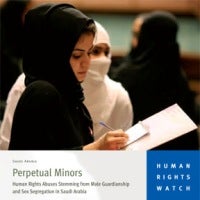
Human Rights Watch - Saudi Women are "Perpetual Minors"

Report Cover © 2008 HRW
Sex Segregation Keeps Women Out of Public Life

Saudi Arabia’s male guardianship of women and policies of sex segregation stop women from enjoying their basic rights, Human Rights Watch said in a new report. Saudi women often must obtain permission from a guardian (a father, husband, or even a son) to work, travel, study, marry, or even access health care.

Sunday, March 23, 2008

Stanley Ann Dunham Obama Soetoro


International Herald Tribune

A mother's unconventional life is reflected within Obama
Thursday, March 13, 2008

In the capsule version of the Barack Obama story, his mother is simply the white woman from Kansas. The phrase comes coupled alliteratively to its counterpart, the black father from Kenya. On the campaign trail, Obama has called her his "single mom." But neither description begins to capture the unconventional life of Stanley Ann Dunham Soetoro, the parent who most shaped Obama.

Kansas was merely a way station in her childhood, wheeling westward in the slipstream of her furniture-salesman father. In Hawaii, she married an African student at age 18. Then she married an Indonesian, moved to Jakarta, became an anthropologist, wrote an 800-page dissertation on peasant blacksmithing in Java, worked for the Ford Foundation, championed women's work, helped bring microcredit to the world's poor.

She had high expectations for her children. In Indonesia, she would wake her son at 4 a.m. for correspondence courses in English before school; she brought home recordings of Mahalia Jackson, speeches by Martin Luther King. And when Obama asked to stay in Hawaii for high school rather than return to Asia, she accepted living apart - a decision her daughter says was one of the hardest in her life.

"She felt that, somehow, wandering through uncharted territory, we might stumble upon something that will, in an instant, seem to represent who we are at the core," said Maya Soetoro-Ng, Obama's half-sister. "That was very much her philosophy of life - to not be limited by fear or narrow definitions, to not build walls around ourselves and to do our best to find kinship and beauty in unexpected places."

Soetoro, who died of ovarian cancer in 1995, was the parent who raised Obama, the Illinois Democrat running for president. He barely saw his father after the age of 2. Though it is impossible to pinpoint the imprint of a parent on the life of a grown child, people who knew Soetoro well say they see her influence unmistakably in Obama.

They were close, her friends and his half-sister say, though they spent much of their lives with oceans or continents between them. He would not be where he is today, he has said, had it not been for her. Yet he has also made some different choices - marrying into a tightly knit, African-American family rooted in Chicago's South Side, becoming a churchgoing Christian, publicly recounting his search for his identity as a black man.

Some of what he has said about his mother seems tinged with a mix of love and regret. He has said his biggest mistake was not being at her bedside when she died. And when The Associated Press asked the candidates about "prized keepsakes" - others mentioned signed baseballs, a pocket watch, a "trophy wife" - Obama said his was a photograph of the cliffs of Oahu's South Shore where his mother's ashes were scattered.

"I think sometimes that had I known she would not survive her illness, I might have written a different book - less a meditation on the absent parent, more a celebration of the one who was the single constant in my life," he wrote in the preface to his memoir, "Dreams from My Father." He added, "I know that she was the kindest, most generous spirit I have ever known, and that what is best in me I owe to her."

In a campaign in which Senator John McCain, the presumptive Republican nominee, has made liberal use of his globe-trotting 96-year-old mother to answer suspicions that he might be an antique at 71, Obama, who declined to be interviewed for this article, invokes his mother's memory sparingly. In one ad, she appears fleetingly - porcelain-skinned, raven-haired and holding her toddler son.

"My mother died of cancer at 53," he says in the ad, which focuses on health care. "In those last painful months, she was more worried about paying her medical bills than getting well."

He has described her as a teenage mother, a single mother, a mother who worked, went to school and raised children at the same time. He has credited her with giving him a great education and confidence in his ability to do the right thing. But, in interviews, friends and colleagues of Soetoro shed light on a side of her that is less well known.

"She was a very, very big thinker," said Nancy Barry, a former president of Women's World Banking, an international network of microfinance providers, where Soetoro worked in New York City in the early 1990s. "I think she was not at all personally ambitious, I think she cared about the core issues and I think she was not afraid to speak truth to power."

Her parents were from Kansas - her mother from Augusta, her father from El Dorado, a place Obama first visited in a campaign stop in January. Stanley Ann - her father wanted a boy so he gave her his name - was born on an army base during World War II. The family moved to California, Kansas, Texas and Washington in restless pursuit of opportunity before landing in Honolulu in 1960.

In a Russian class at the University of Hawaii, she met the school's first African student, Barack Obama. They married and had a son in August 1961, in an era when interracial marriage was rare. Her parents were upset, Obama learned years later from his mother, but they adapted.

The marriage was brief. In 1963, Obama left for Harvard, leaving his wife and child. She then married Lolo Soetoro, an Indonesian student. When he was summoned home in 1966 after the turmoil surrounding the rise of Suharto, Stanley Ann Soetoro and Barack followed.

Those choices were not entirely surprising, said several high school friends of Soetoro, whom they remembered as unusually intelligent, curious and open. She never dated "the crew-cut, white boys," said one friend, Susan Blake. "She had a world view, even as a young girl. It was embracing the different, rather than that ethnocentric thing of shunning the different. That was where her mind took her."

Her second marriage faded, too, in the 1970s. She wanted to work, one friend said, and Lolo Soetoro wanted more children. He became more American, she once said, as she became more Javanese.

"There's a Javanese belief that if you're married to someone and it doesn't work, it will make you sick," said Alice Dewey, an anthropologist and friend. "It's just stupid to stay married."

That both unions ended is beside the point, some friends suggested. Soetoro remained loyal to both husbands and encouraged her children to feel connected to their fathers. In reading drafts of her son's memoir, Obama has said, she did not comment upon his depiction of her but was "quick to explain or" defend the less flattering aspects of my father's character."

By 1974, Soetoro was back in Honolulu, a graduate student and raising Barack and Maya, nine years younger. Barack was on scholarship at a prestigious prep school, Punahou. When Soetoro decided to return to Indonesia three years later for her field work, Barack chose not to go.

"I doubted what Indonesia now had to offer and wearied of being new all over again," he wrote in his memoir. "More than that, I'd arrived at an unspoken pact with my grandparents: I could live with them and they'd leave me alone so long as I kept my trouble out of sight."

During those years, he was "engaged in a fitful interior struggle. I was trying to raise myself to be a black man in America."

Soetoro-Ng recalled her mother's quandary. "She wanted him to be with her," Soetoro-Ng said. But, she added, "although it was painful to be separated from him for his last four years of high school, she recognized that it was perhaps the best thing for him. And she had to go to Indonesia at that time."

Barack spent summers and Christmas vacations with his mother; they communicated by letters.

Fluent in Indonesian, Soetoro moved with Maya first to Yogyakarta, the center of Javanese handicrafts. A weaver in college, she was fascinated with what Soetoro-Ng calls "life's gorgeous minutiae." That interest inspired her study of village industries, which became the basis of her 1992 doctoral dissertation.

"She loved living in Java," said Dewey, who recalled accompanying Soetoro to a metal-working village. "People said, 'Hi! How are you?' She said, 'How's your wife? Did your daughter have the baby?' They were friends. Then she'd whip out her notebook and she'd say, 'How many of you have electricity? Are you having trouble getting iron?' "

She became a consultant for the United States Agency for International Development on setting up a village credit program, then a Ford Foundation program officer in Jakarta specializing in women's work. Later, she was a consultant in Pakistan; then she joined Indonesia's oldest bank to work on what is described as the world's largest sustainable microfinance program, creating services like credit and savings for the poor.

Visitors flowed constantly through her Ford Foundation office in central Jakarta and through her house in a neighborhood to the south, where papaya and banana trees grew in the front yard and Javanese dishes like opor ayam were served for dinner. Her guests were leaders in the Indonesian human rights movement, people from women's organizations, representatives of community groups doing grass-roots development.

As a mother, Soetoro was both idealistic and exacting. Friends describe her as variously informal and intense, humorous and hard-headed. She preached to her young son the importance of honesty, straight talk, independent judgment. When he balked at her early-morning home schooling, she retorted, "This is no picnic for me either, buster."

When Barack was in high school, she confronted him about his seeming lack of ambition, Obama wrote. He could get into any college in the country, she told him, with just a little effort.

He says he looked at her, so earnest and sure of his destiny: "I suddenly felt like puncturing that certainty of hers, letting her know that her experiment with me had failed."

Soetoro-Ng remembers conversations with her mother about philosophy or politics, books, esoteric Indonesian woodworking motifs. One Christmas in Indonesia, Soetoro found a scrawny tree and decorated it with red and green chili peppers and popcorn balls.

"She gave us a very broad understanding of the world," her daughter said. "She hated bigotry. She was very determined to be remembered for a life of service and thought that service was really the true measure of a life."

Many of her friends see her legacy in Obama - in his self-assurance and drive, his boundary bridging, even his apparent comfort with strong women. Some say she changed them, too.

After her diagnosis, Soetoro spent the last months of her life in Hawaii, near her mother. (Her father had died.)

Obama has recalled talking with her in her hospital bed about her fears of ending up broke. She was not ready to die, he has said. Even so, she helped him and Maya "push on with our lives, despite our dread, our denials, our sudden constrictions of the heart."

She died in November 1995, as Obama was starting his first campaign for public office. After a memorial service at the University of Hawaii, one friend said, a small group of friends drove to Oahu's South Shore. With the wind whipping the waves onto the rocks, Obama and Soetoro-Ng placed their mother's ashes in the Pacific, sending them off in the direction of Indonesia.


International Herald Tribune Copyright © 2008 The International Herald Tribune | www.iht.com

Sunday, March 16, 2008

"It's about race and class"

Published: March 16, 2008
If the Spitzer affair causes us to lose sight of the broader reality of prostitution, then the biggest loser will be the girls for whom selling sex isn’t a choice but a nightmare.